
Reward-Based Dog Training That Builds Better Habits
Treats can be extremely useful during obedience training, but only when they are paired with clear communication and consistent follow-through. Effective reward-based dog training is not about carrying food forever or bribing your dog whenever you need cooperation. It is about helping your dog understand which behavior earned the reward.
At Off Leash K9 Training of Kansas City, I often meet owners whose dogs respond perfectly when they see a treat but ignore commands when the food disappears. That usually means the dog has learned to follow the reward rather than fully understand the command.
The solution is not necessarily to stop using treats. Instead, owners need to improve their timing, expectations, and training structure. When rewards are used thoughtfully, they can support faster learning, build dog confidence, and create a positive foundation for long-term obedience.
Choose Rewards That Match the Training Environment
Not every reward has the same value to every dog. A piece of kibble may be exciting in your living room but completely unimportant at a busy Kansas City park.
Successful reward-based dog training starts with understanding what motivates your individual dog. Some dogs work eagerly for food, while others may prefer praise, play, toys, or access to an activity they enjoy.
It can help to create a simple reward hierarchy:
- Low-value rewards: Kibble or familiar dry treats for easy skills at home
- Medium-value rewards: Small commercial treats for yard or neighborhood practice
- High-value rewards: Soft, flavorful treats for new skills or distracting environments
- Nonfood rewards: Praise, toys, play, sniffing, or permission to move forward
The American Kennel Club explains that dogs may need more motivating rewards when practicing difficult skills or working around distractions. It also recommends keeping training treats small so dogs can complete several repetitions without becoming full. You can read more in the AKC’s guide to using food rewards in dog training.
At Off Leash K9 Training of Kansas City, we help owners determine when food is useful and when another form of reinforcement may be more appropriate.
Reward the Exact Behavior You Want
Timing is one of the most important parts of reward-based dog training. If the reward comes too late, your dog may connect it with an entirely different action.
For example, imagine asking your dog to sit. The dog sits, immediately stands, jumps toward you, and then receives a treat. From the dog’s perspective, jumping may have earned the reward.
Try to deliver the reward while your dog is still performing the desired behavior:
- Give the command once.
- Wait for the correct response.
- Mark the behavior with a consistent word such as “yes.”
- Deliver the reward promptly.
- Reset and repeat.
Reward placement also matters. If you are teaching heel, deliver the treat next to your leg instead of reaching forward and encouraging your dog to move ahead. If you are teaching place, reward your dog while all four paws remain on the designated surface.
The AKC notes that delayed rewards can confuse dogs, while a consistent marker can identify the precise moment the dog performs the desired behavior.
Our article about dog training treats for better obedience at home provides additional guidance for turning food into a communication tool rather than a permanent lure.
Stop Showing the Treat Before Every Command
One common mistake in reward-based dog training is showing the dog a treat before asking for every behavior. Over time, the visible food becomes part of the command.
The dog may begin to think, “I sit when I see food,” instead of, “I sit when I hear the command.”
To prevent that habit:
- Keep rewards in a pocket or treat pouch.
- Give the command before reaching for the reward.
- Mark the correct behavior first.
- Retrieve the treat only after your dog responds.
- Occasionally use praise, play, or another reward instead.
This distinction separates a lure from a reward. A lure helps guide a dog into a new position during the early learning stage. A reward comes after the dog completes a known behavior.
The visible lure should usually be faded as the dog begins to understand the command. The AKC recommends moving from a food-filled hand to an empty-hand signal so the dog does not become dependent on seeing food before responding.
Owners who need help moving beyond treat-dependent behavior can explore our Basic & Advanced Obedience training options.
Regional Dog-Friendly Business Spotlight
Choji Chews is a dog treat business located in Kansas City, Missouri. The company offers homemade dog treats made with natural ingredients, including gluten-free options for dogs with sensitive stomachs. Its products include both crunchy and soft treats.
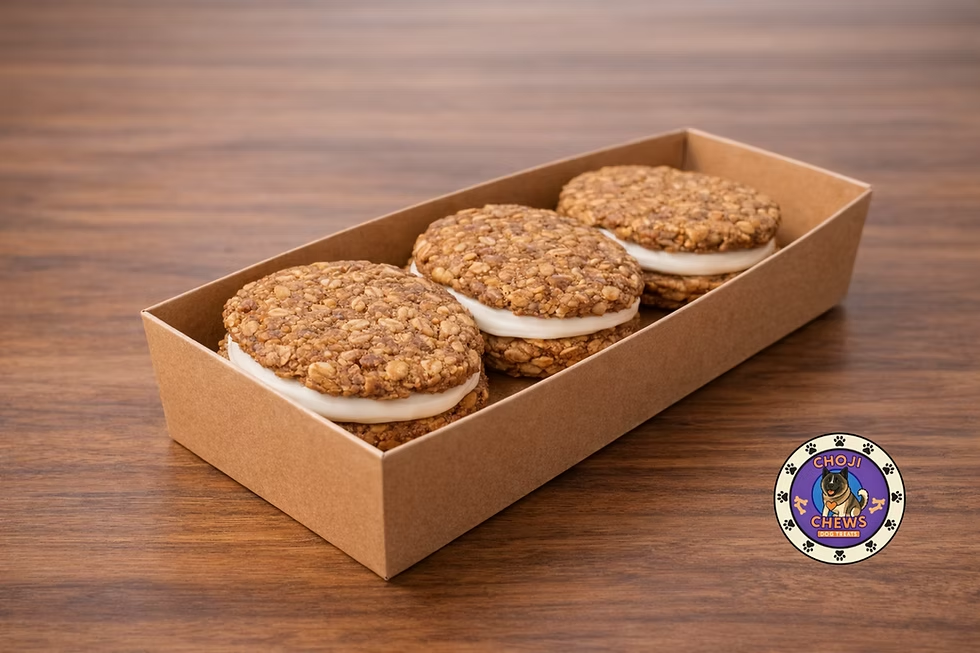
A local dog treat business can give owners convenient reward options for training sessions, walks, and real-world obedience practice. Smaller treats can be especially useful when teaching new commands because they allow owners to complete several repetitions without interrupting the flow of the session.
When choosing treats for reward-based dog training, owners should consider size, texture, ingredients, and how quickly the dog can eat the reward. A large biscuit that takes a minute to finish may be appropriate as an occasional snack, but it can slow down a focused obedience session. The AKC recommends fast-eating treats when owners need a high rate of reinforcement and longer-lasting options when encouraging calm behavior.
Choji Chews is featured as a regional dog-related resource. It is separate from Off Leash K9 Training of Kansas City and is not being presented as a dog training provider.
Add Structure Instead of Relying on Food Alone
Rewards are valuable, but reward-based dog training still requires boundaries, repetition, and clear expectations.
Your dog should not receive a treat for partially completing a familiar command. If you ask for place and your dog steps onto the bed before immediately walking away, the full behavior has not been completed.
Build reliability by gradually increasing:
- The length of time your dog holds a command
- Your distance from your dog
- The number of distractions nearby
- The variety of training locations
- The number of different people giving commands
Change only one difficulty level at a time. If your dog can hold place for thirty seconds at home, do not immediately expect ten minutes on a busy patio.
For households with more than one dog, our guide to multi-dog training success explains why each dog should understand commands individually before practicing together.
Reduce Treats Without Removing Reinforcement
Once a behavior becomes reliable, you can begin varying the type and frequency of rewards. This does not mean your dog should never be rewarded again.
Instead of giving food after every familiar command, rotate between:
- Verbal praise
- Physical affection
- A favorite toy
- Permission to sniff
- Going through a doorway
- Continuing the walk
- An occasional food reward
This stage of reward-based dog training helps your dog understand that cooperation can lead to many positive outcomes, even when food is not visible.
Keep rewarding more generously when teaching something new, working in a difficult environment, or asking for exceptional effort. Familiar commands in easy settings can receive simpler reinforcement.
Ready to Build Reliable Obedience?
Treats can help dogs learn, but timing, structure, and consistency are what turn a temporary response into dependable behavior.
Through thoughtful reward-based dog training, you can teach your dog to respond without needing to see food first. You can also build stronger obedience training, better dog confidence, and clearer communication during everyday life.
Off Leash K9 Training of Kansas City helps owners throughout Kansas City, MO/KS develop practical skills through Private Lessons, Puppy Training, Board and Train, and Off-Leash Obedience programs.
Contact Off Leash K9 Training of Kansas City to start building reliable obedience that works at home and around real-world distractions.